Generative AI has rapidly transformed the way we create music and other creative artifacts. Yet, behind these impressive advancements lies a fundamental hurdle that the research community has yet to solve: How do we actually evaluate these systems?
The Evaluation Crisis in Creative AI
Right now, the AI field relies heavily on static benchmarks and single-score leaderboards. We often rush to adopt uninterpretable, single-score proxies, such as the Fréchet Audio Distance (FAD), to evaluate highly complex, multidimensional cultural artifacts (Lerch, 2025).
But creative AI and music pose unique challenges. Trying to compress musical quality into a single number leads to what I call an evaluation crisis characterized by four systemic failures:
- Validity Failure: Automated metrics often fail to measure the actual musical or user-facing qualities they are intended to target.
- Leaderboard Failure: Optimizing for a single score encourages overfitting and obscures critical trade-offs.
- Comparability Failure: The use of different datasets, features, and metrics makes cross-paper comparison unreliable.
- Governance Failure: No shared process exists to update evaluation benchmarks as models and dataset standards evolve.
A New Paradigm: Shifting to a Dynamic Ecosystem
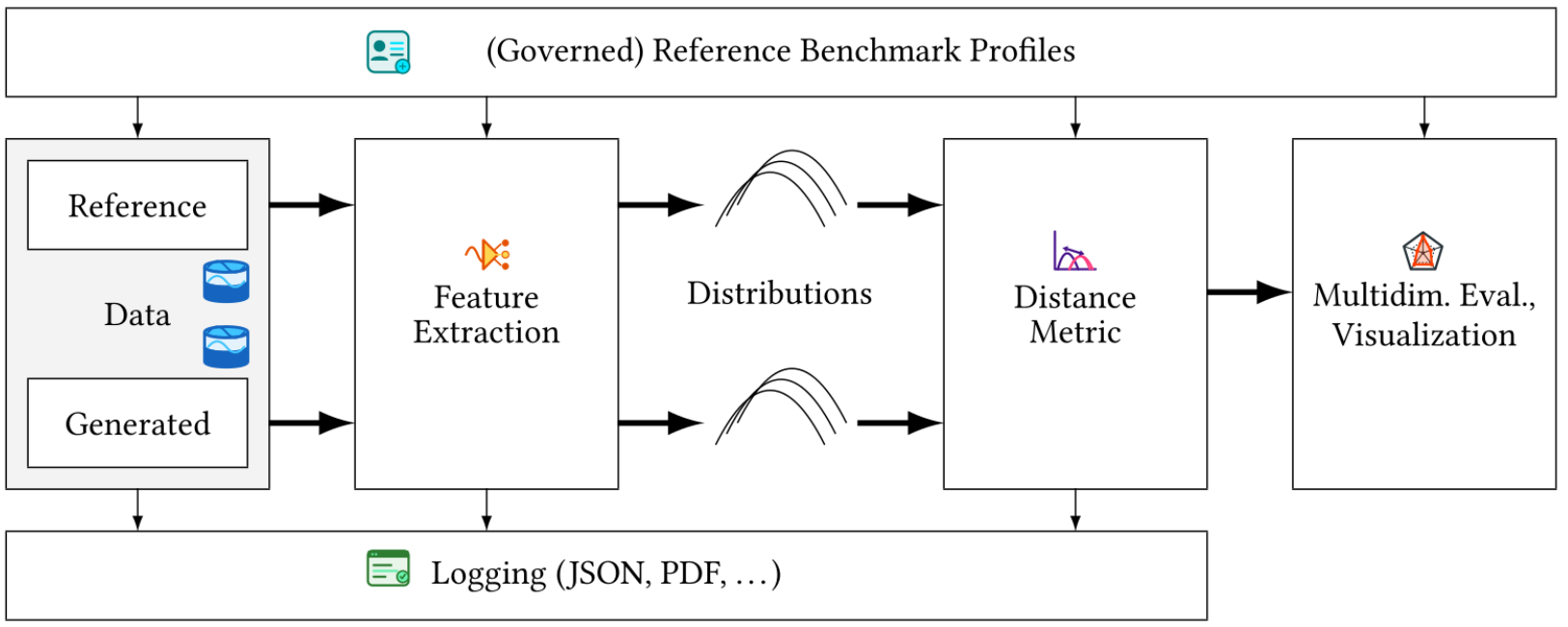
To solve this, I propose a paradigm shift from rigid benchmarking to an evolving, multidimensional, and community-governed evaluation ecosystem. Rather than boxing researchers into a single static metric, the proposed framework cleanly decouples three core components: reference data, feature representations, and distance metrics. This modularity ensures the pipeline can easily extend and grow alongside generative models.
The core components of the proposed framework are:
- Reference Benchmark Profiles (RBPs): To maintain cross-study standardization without sacrificing domain flexibility, the framework introduces RBPs. These are curated, versioned configurations that define the appropriate datasets, metrics, and features for specific musical genres or use cases (e.g., music for advertisements).
- A Dual-Track Feature Strategy: We shouldn’t have to choose between interpretability and performance. The framework implements an explanatory track utilizing interpretable features (like timbre, pitch chroma, and tempo descriptors) alongside a dense track utilizing learned embeddings (like CLAP or MERT).
- Multidimensional Assessment and Visualizations: No more single-score rankings. The framework aggregates metrics into a multi-axis vector, allowing researchers to view model performance across distinct musical and technical dimensions using intuitive radar charts.
- Community Governance: An open-source framework is only as good as the community behind it. The ecosystem is designed to be steered by a consortium of institutional and community stakeholders to approve, version, and deprecate profiles transparently.
By establishing evaluation as a transparent, evolving process rather than a static metric, this framework outlines a practical roadmap toward the meaningful assessment of creative AI. Ensuring that our tools are flexible, multidimensional, and community-steered allows the field to move past uninterpretable metrics and build an authentic foundation for future innovation. I will present this concept at the ACM AI Leadership Summit. The preprint is available here. The poster is available on github